Playing in the space between
In collaboration with:

With the support of:



 Wikicommons Aerial photo by KLM Aerocarto Schiphol-Oost, 24 February 1960 17661
Burgerweeshuis Aldo van Eyck
Wikicommons Aerial photo by KLM Aerocarto Schiphol-Oost, 24 February 1960 17661
Burgerweeshuis Aldo van Eyck
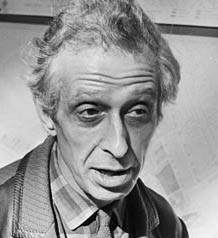
He opposed the functional and rational thinking of modernism, which divided the world into opposites: inside/outside, public/private, work/rest, city/nature, old/new, child/adult. For him, meaning lay precisely in the area between those extremes: the space of encounter, transition and relationship. Architecture should not separate, but connect, thereby restoring a human scale to an overly rational world. We head to Amsterdam in search of this interplay of spaces in between.
He literally put this idea into practice in his Amsterdam playgrounds from the 1950s and 1960s. They were not enclosed, but located precisely between blocks of houses, as open spaces where children could play and local residents could meet. The Burgerweeshuis (1960) is another example of this connecting principle. Designed as a network of small spaces, courtyards and passageways, the interior and exterior flow into one another; each transition becoming a place in itself, full of nuance and meaning. Van Eyck was inspired by anthropology and phenomenology. He believed that meaning arises between people and things, in the experience of place and moment.
In collaboration with the Van Eesteren Museum, named after Cornelis Van Eesteren, the architect-urban planner who laid the blueprint for the post-war growth of the Dutch capital with the Amsterdam Expansion Plan (AUP), we visit a number of key works from Aldo van Eyck’s oeuvre, including buildings (the Burgerweeshuis and the Humbertushuis) and a number of public spaces and playgrounds.
 Stadarchief Amsterdam
IJsbaanpad 3, Burgerweeshuis. Architect Aldo E. van Eyck. Prijswinnaar van de Merkelbachprijs 1964
Stadarchief Amsterdam
IJsbaanpad 3, Burgerweeshuis. Architect Aldo E. van Eyck. Prijswinnaar van de Merkelbachprijs 1964
The Burgerweeshuis
In 1954, Aldo van Eyck was commissioned to build a new children’s home on the IJsbaanpad in Amsterdam-Zuid. Six years later, the new Burgerweeshuis was completed. The Burgerweeshuis is internationally regarded as a key work of post-war modernism. After being used as a care facility, academy building and office, the listed building stood empty for a long time and fell into disrepair.
Originally, the complex accommodated 125 children in eight pavilions, connected to various service areas. The pavilions were designed as dwellings situated along an inner street. This gives the building its characteristic layout. A distinctive feature is the generic structure of exposed concrete with infills in visible brickwork, translucent or transparent material, with roofs formed by eight large and 328 small roof domes. Although the infills and fixed furnishings give each space a very specific character, the Burgerweeshuis is considered the origin of structuralism, a movement based on the power of a freely fillable structure.
In 2017, the inspiring building was completely renovated under the direction of Wessel de Jonge’s architectural firm and landscape architects Atelier Quadrat. The tough coating was removed from the concrete façade sections, which were then carefully restored, and the brickwork was repaired and cleaned. The window frames, which were replaced by Van Eyck around 1993, were painted in their original colours and the glass was replaced. The outdoor areas and grounds are being redesigned based on the original design and current requirements.
The Playgrounds
In 1947, at the age of 28, Aldo van Eyck joined the Amsterdam Public Works Department, Urban Development Division. After a short period working on urban expansion projects, he was commissioned to design a playground on the Bertelmanplein. At that time, Amsterdam only had enclosed playgrounds managed by playground associations. Children had to be members to be able to play there. There were few or no play facilities for children in the residential neighbourhoods themselves. On the initiative of Jakoba Mulder, who headed the design group of which Aldo van Eyck was a member, a plan was launched to give every neighbourhood in Amsterdam a small public playground. The first playground on the Bertelmanplein was an experiment. Aldo van Eyck designed a wide-edged sandpit for the square, in which he placed four round stones and a climbing arch. The sandpit was placed eccentrically in the north corner of the square. Diagonally across from the sandpit were three climbing frames, and the square was bordered by trees and five benches. The playground was a success. Many designs followed, with Aldo van Eyck using a number of compositional techniques depending on the location. The playgrounds allowed him to put his ideas about architecture, relativity and imagination into practice.
 Stadarchief Amsterdam
Hélene Swarthstraat, Overzicht met speelplaats naar een ontwerp van Aldo van Eyck
Stadarchief Amsterdam
Hélene Swarthstraat, Overzicht met speelplaats naar een ontwerp van Aldo van Eyck

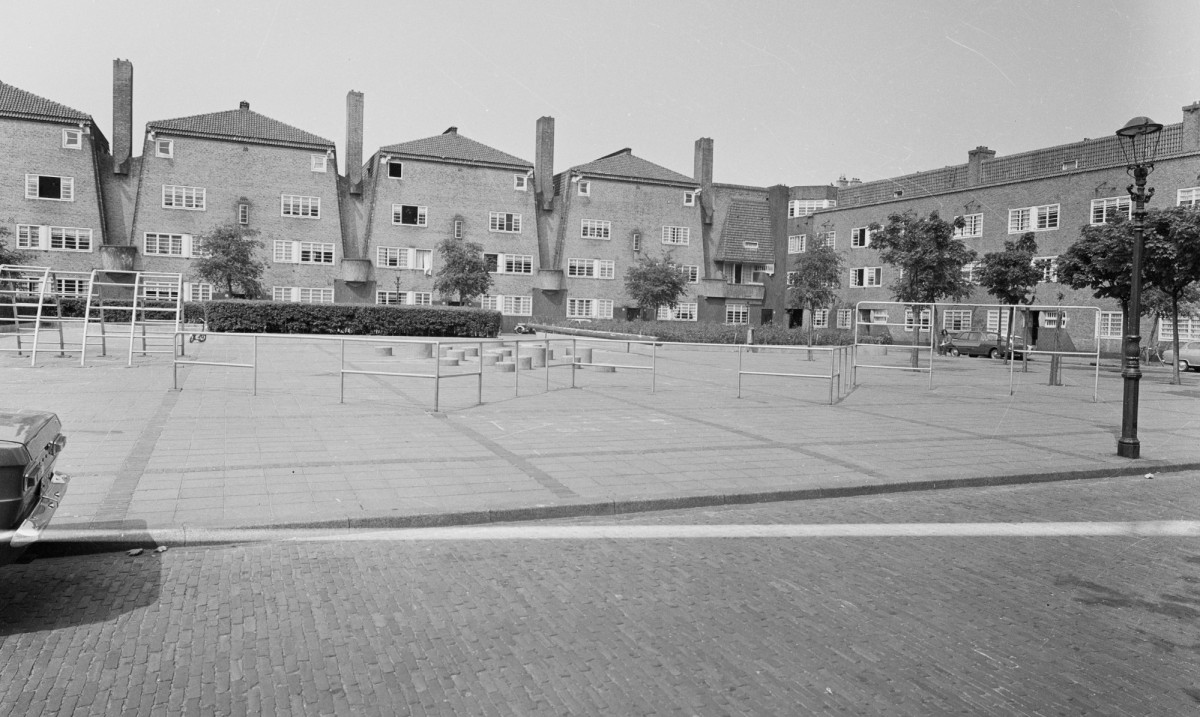 Stadarchief Amsterdam
Henriëtte Ronnerplein. In de voorgrond een speelplaats naar ontwerp van Aldo en Hanny van Eyck
Stadarchief Amsterdam
Henriëtte Ronnerplein. In de voorgrond een speelplaats naar ontwerp van Aldo en Hanny van Eyck
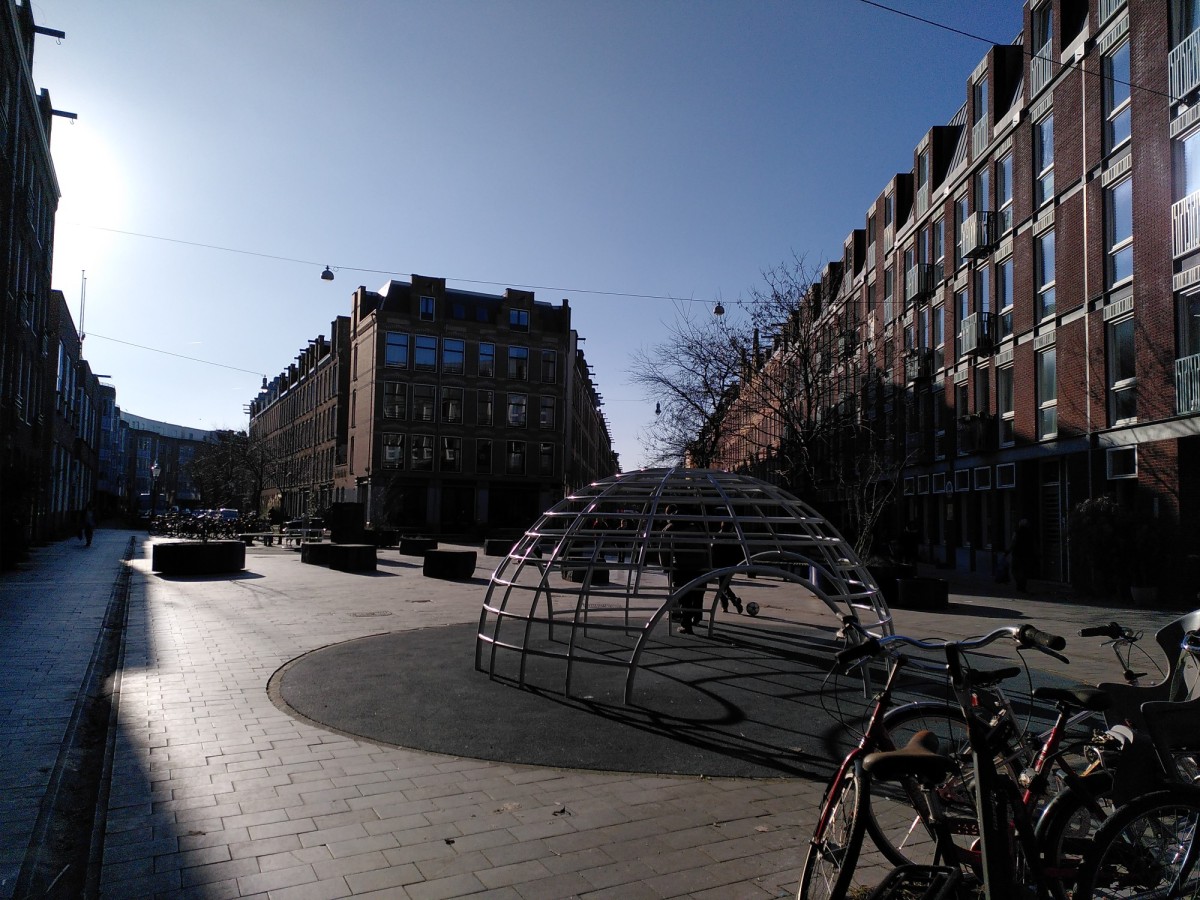
Relativity referred to a reality in which the coherence of the elements was determined by their mutual relationships and not by a central, hierarchical ordering principle. As a result, reality was no longer dominated by a fixed centre, but all elements were equal. The playgrounds designed by Aldo van Eyck can be seen as exercises in non-hierarchical compositions. Through the placement of various elements, including benches, trees and hedges, and by using different colours of paving slabs, the slender metal climbing frames became just as important and were just as present as the large concrete sandpit, which also radiated a certain softness due to its round shape or rounded corners.
The play equipment, such as the monkey bars, climbing arch, climbing dome and climbing funnel, was designed by Aldo van Eyck himself and tested by his children. He considered the design of the play equipment to be an integral part of the design assignment. The play elements had to stimulate the children’s imagination. In addition to climbing and diving, the climbing arch could also serve as a talking hill, a lookout post, and, with a blanket over it, as a hut. Sandboxes, climbing arches and stepping stones were installed throughout the Netherlands.
The playground programme was drawn up in consultation with the neighbourhood by the Site Preparation Department of the Urban Development Service. They also decided where the playgrounds would be located. Because the Urban Development Service wanted to create a playground in every neighbourhood, vacant lots in the city centre were converted into playgrounds, most of them temporary. It is these playgrounds between old walls and cluttered buildings that are best known.
Of the seven hundred playgrounds designed by Aldo van Eyck between 1947 and 1978, ninety remained in 2001 with their original layout intact, albeit sometimes supplemented with other play objects not designed by him. In 2002, the Stedelijk Museum in Amsterdam organised a retrospective exhibition on the playgrounds and mapped them all for the occasion. Some playgrounds have long since disappeared, but that is not important; what matters is the place: ‘they are points where the seeds of community were sown, where the city is not to be viewed and consumed, but lived.’
Van Eesteren Museum
The Van Eesteren Museum presents a broad and contemporary narrative on urban planning, based on the history of Amsterdam’s post-war expansion districts. The museum focuses on the life and ideas of urban planner Cornelis van Eesteren and his team, in which Aldo van Eyck played a significant role. The Nieuw-West district, where the museum is located, was part of the General Expansion Plan, also known as the AUP. This was an expansion plan from 1935 that was intended to facilitate the housing needs of the population until the year 2000. Van Eesteren was at the forefront of the plan, which was based on the principles of ‘light, air and space’.
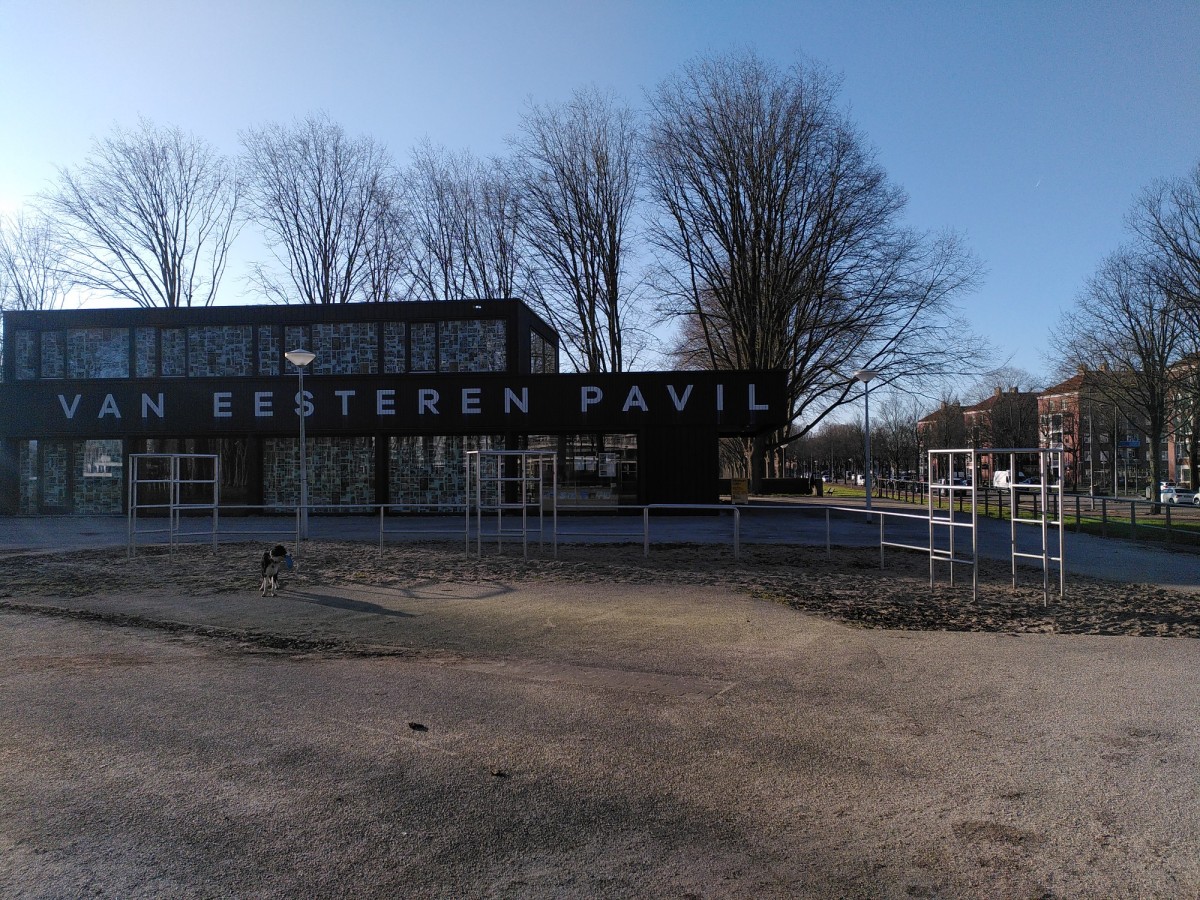
The Van Eesteren Museum is located in the heart of Amsterdam Nieuw-West and consists of an outdoor museum, an indoor museum and a 1950s museum house. The museum organises various exhibitions, walks, excursions, talks and other activities. Since 2017, the museum has been housed in a newly built museum pavilion on the Sloterplas, designed by Korteknie Stuhlmacher architects.
The trip will take place on both the first Saturday in March and the first Saturday in April.
The trip will combine interior visits with a bike route through Amsterdam, discovering various aspects of van Eyck’s oeuvre.
Programme
1960 Burgerweeshuis – Aldo van Eyck
1994 Tripolis en 2023 renovatie en uitbreiding – MVRDV
2017 Van Eesteren Paviljoen – Korteknie Stuhlmacher Architecten
1947 – 1978 Diverse speelplaatsen – Aldo van Eyck
1978 Hubertushuis – Aldo en Hannie van Eyck
1983 Pentagon + Nieuwmarktbuurt – Aldo van Eyck en Theo Bosch