Between heritage and vilification: modernism in Bruges (2.0)
In collaboration with:


With the support of:



 Matthias Desmet
Axel Ghyssaert – Architectenwoning Axel Ghyssaert – 1969
Matthias Desmet
Axel Ghyssaert – Architectenwoning Axel Ghyssaert – 1969
After the war, Bruges expanded beyond its historic boundaries. Grasslands made way for new housing zones with the necessary social infrastructure. There was a lot of land parcelling, but also experimentation: with new forms, materials and construction techniques. Between 1945 and 1980, leading architects such as Peter Callebout, Ivan Claeys, the duo Vivian Desmet and Jozef Depuydt, Arthur Degeyter, Paul Felix, Axel Ghyssaert, Hendrik Scherpereel, Jan Tanghe, Eugène Vanassche, Christ Vastesaeger, and others expanded their oeuvre around Bruges. Today, this ‘young heritage’ is under pressure. We visit a number of key works from this period, caught between heritage and vilification.
Archipel goes on a trip, on foot or by bicycle, to (re)discover architectural gems in Flemish cities. Let’s hit the road together! The route along modernist projects on the outskirts of Bruges is also a call for renewed appreciation and protection of these buildings.
On Saturday 5 September, we will cycle through the green belt around Bruges, an area where the post-war growth of the city centre is still visible and tangible in a colourful mix of styles and typologies. New residential areas, schools, religious centres and even a new tram line have made modern life in the suburbs, connected to the historic centre, attractive.
In the neighbouring municipalities, which were still independent entities at the time, there was a building boom between 1945 and 1980. Grasslands made way for neighbourhoods with the necessary social infrastructure, and a series of design competitions were organised – some of which were later implemented – for projects that were intended to reflect the affluent society.
It was a period of intensive land parcelling throughout Flanders, but also of experimentation: with new forms, materials and construction techniques; in which architects, inspired by trade journals and international travel, sought to transcend the Flemish style of land parcelling and introduce concepts for modern living, based on fundamental qualities such as simplicity, balance and connection with nature.
It is also a period that still receives (too) little public attention today, because the buildings are not yet considered to be of historical value. As a result, this ‘young heritage’ is coming under increasing pressure: the structures do not meet current EPB requirements, renovations that respect the design require additional investment, and due to their attractive location on spacious plots, new owners are quick to opt for the most efficient solution: tabula rasa.
This is also the case in Bruges, where between 1945 and 1980 a number of leading architects such as Peter Callebout, Ivan Claeys, the duo Vivian Desmet and Jozef Depuydt, Arthur Degeyter, Paul Felix, Axel Ghyssaert, Hendrik Scherpereel, Jan Tanghe, Eugène Vanassche, Christ Vastesaeger, and others developed their oeuvre, often in collaboration with like-minded visual artists who sat around the drawing board with them, sometimes as clients, sometimes as co-designers.
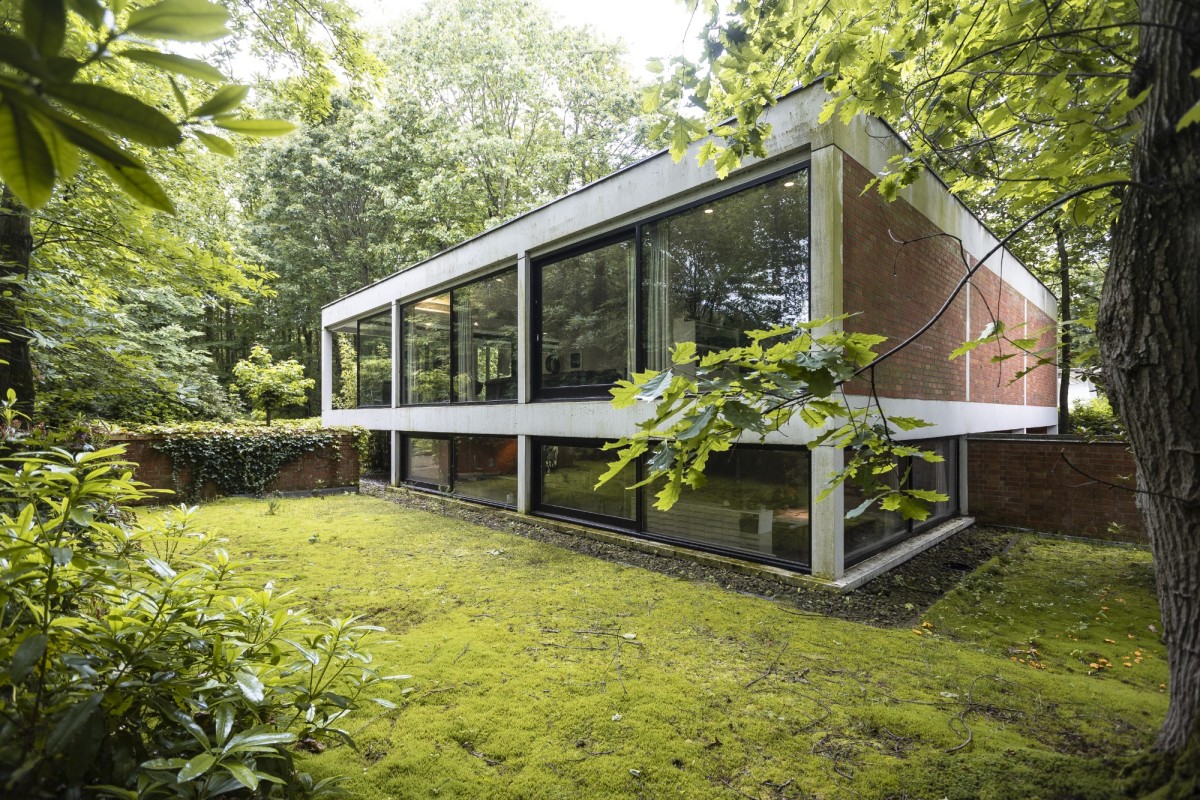 Matthias Desmet
Ivan Claeys – Architectenwoning Ivan Claeys – 1968
Matthias Desmet
Ivan Claeys – Architectenwoning Ivan Claeys – 1968
 Matthias Desmet
Peter Callebout – Woning Van Hoorebeke – 1962
Matthias Desmet
Peter Callebout – Woning Van Hoorebeke – 1962
 Matthias Desmet
Axel Ghyssaert – Architectenwoning Axel Ghyssaert – 1969
Matthias Desmet
Axel Ghyssaert – Architectenwoning Axel Ghyssaert – 1969
Together, they realised some 115 projects across the city that are not (yet) included in the database of Immovable Heritage Flanders. As a result, they are at great risk of undergoing major renovations or even complete demolition. Unfortunately, several remarkable buildings have already disappeared in recent decades, and Bruges is no exception. We are seeing more and more reports of modernist heritage under threat. It is therefore high time for action!
Together with the City of Bruges – which is committed to raising awareness of this modernist heritage in the coming years – and numerous local and Flemish partners, Archipel remains committed to making this heritage visible and keeping it that way in 2026.
Following our cycle tour Bruges modernism: a marginal case? we will be getting back on our bikes in the autumn to get to know the work of these architects better, both inside and out. We will be stimulating discussion about the significance of this modernist heritage and, above all, about what comes next.
How can we give this fragile heritage a new voice or purpose, so that future generations can continue to enjoy it? How do designers such as Arthur Degeyter, Axel Ghyssaert, Hendrik Scherpereel and Ivan Claeys look back on their work, and how do their oeuvres relate to each other? And what does all this mean for the city of today and tomorrow?
We would like to invite you to join us on 5 September to discover this and gain a new perspective on what Bruges also is.