Between architecture and landscape
In collaboration with:

With the support of:



 Tsukamoto Lab
Satoyama landscape
Tsukamoto Lab
Satoyama landscape
Within this balance between human and natural ecosystems, nature and agriculture are in equilibrium, resulting in unique landscapes. In this search between control and letting go, architecture is built with materials from forests and fields to serve the equilibrium of the rural community.
Atelier Bow-Wow proposes a form of architecture capable of creating relationships and environments that are in harmony with nature, based on a conscious use of local resources and a deep sense of care for the networks in which architecture is embedded. The projects always start with the specific materials and networks available at a particular time and place.
An important part of Atelier Bow-Wow’s practice is disaster response. In their work, they respond not only to sudden disasters, but also to the “slow disaster” of rural areas, such as depopulation and the loss of traditional livelihoods. Projects such as the Hakami Satoyama House (2023) in Shimane Prefecture, where three rental houses were built with local timber to attract new residents, demonstrate this approach. The Kamanuma Village project following the 2011 earthquake shows how they utilise local skills and materials for recovery. Here, rice is cultivated according to a model of collective ownership. Similarly, the Satoyama-Nagaya Hoshinogawa (2019) in Yame City is a complex of rental homes built on the site of a former school using local cedar wood and traditional methods.
All of this contributes to a ‘relational aesthetic’, in which architecture provides a stage for everyday activities and creates new relationships between residents and their environment. By sharing local resources and designing architecture that is accessible and fair to everyone, Atelier Bow-Wow contributes to the sustainability of local culture.
Satoyama School of Design
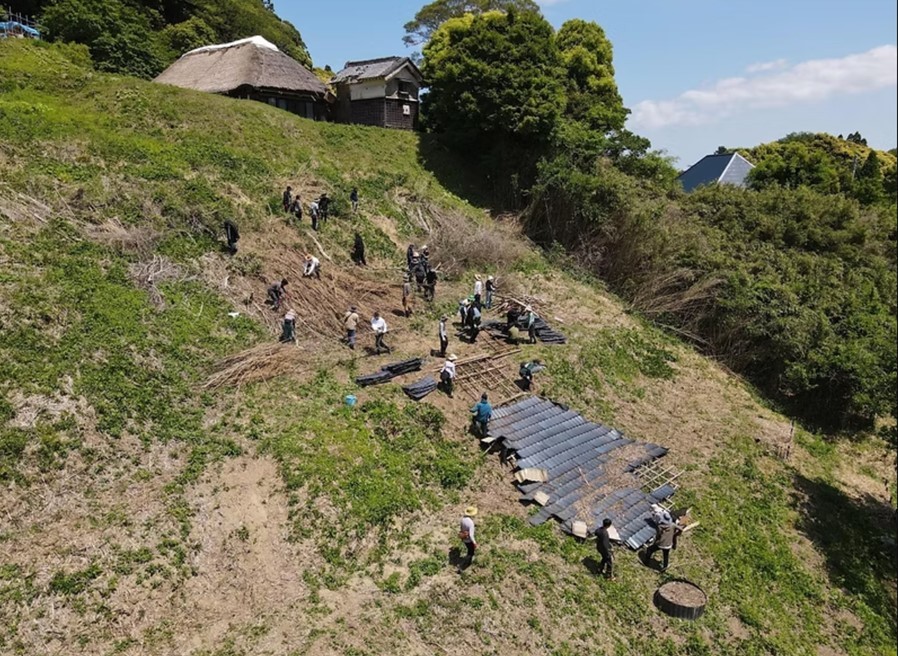
The Satoyama School of Design is part of the Tsukamoto Laboratory at the Tokyo Institute of Technology, led by Yoshiharu Tsukamoto, and aims to revive the satoyama principle. Literally, ‘sato’ means village and ‘yama’ means hill or mountain. In this context, agriculture, forestry and construction are not hierarchically separated, but intertwined in a complex network of mutual dependencies. These complex intertwined landscapes have been disappearing in recent decades, partly due to the ageing population and urbanisation in Japan, which has led to a rural exodus. Since the 1980s, various ecological movements have been fighting to preserve the satoyama landscapes. Professors and students from SSD are collaborating across universities to recultivate fallow fields, preserve the landscape, restore existing structures and build small houses using locally sourced materials, such as recycled building materials, discarded furniture or fallen trees.
Atelier Bow-Wow
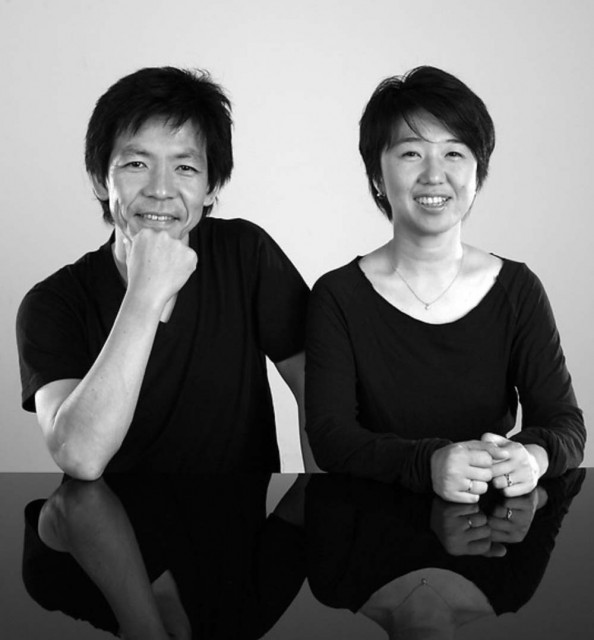
Atelier Bow-Wow was founded in Tokyo in 1992 by Yoshiharu Tsukamoto and Momoyo Kaijima. Yoichi Tamai joined the firm in 2015.
The firm investigates how people live in densely built-up cities and designs based on the everyday use of space. Their theory of ‘Behaviourology’ describes architecture as a system that responds to human behaviour and urban conditions. They are also known for coining the term ‘Pet Architecture’: small, sometimes strange buildings squeezed into the leftover spaces of the city as symbols of urban creativity and resilience.
In addition to thorough theoretical research and extensive architectural projects, the agency regularly organises exhibitions and discursive programmes.
For Atelier Bow-Wow, architecture is not a static entity, but a living part of a broader network in which objects, people, neighbouring buildings, weather conditions and location-specific dynamics actively shape the design process. Architecture is seen as an essential hub within a larger ecosystem. Their work seeks to restore the growing alienation between people, objects and the natural world – a situation that is accelerated by the ideology of capitalist growth. At its core, their practice focuses on one fundamental question: how can architecture and society be redesigned in the light of ecological transformation?
Lecture will be given by Yoshiharu Tsukamoto.