Between me and myself
55 € Archipel members and contributors
75 € non-members
25 € students
Includes coffee, lunch and drink
In collaboration with:


With the support of:



 kana arioka
This symposium draws inspiration from the Japanese concept of ‘ma, the philosophy of in-between,’ to examine the human psyche. Our consciousness, with its self-assured ‘I’, is situated in a headstrong ‘in-between’ where that ‘I’ is by no means in control: a space that opens up a stubborn ‘in-between’ between who I think I am and who I would like to be, between what I desire and what that desire promises to fulfil.
Ma, 間, Japanese for ‘space’, acquired a specific meaning that extends across numerous domains of Japanese culture and which is not always easy for Westerners to grasp. Whereas for us ‘space’ is a neutral quantity, like ‘time’, a ‘dimension’ that allows things to be what they are without exerting any influence on them, the Japanese ma presupposes a space that is subtly connected in some way to the things that are in it, just as those things are affected, influenced, if not determined, by that space. Space is an ‘in-between’ that as such affects that what it is between.
 kana arioka
The architecture of the space ‘between me & myself’: inspired by the Japanese concept of ma (and specifically by the impact of this ma on Japanese architecture), Archipel and Psychoanalysis & Culture are organising a symposium on the space that separates us from our most intimate selves.
Text: Marc De Kesel
Hera Van Sande
Ma: architecture of the in-between
The Japanese concept of ma (間) invites a shift from static space to space as an event. What does it mean to understand space as a relationship? Ma is not emptiness, but a charged interval — a tension between things, people, rhythms and meanings. It is an active condition that determines how something appears, how it is experienced, and how it relates to something else. It is precisely there that space begins to function: in the transition between outside and inside, in the threshold that slows us down, in the shadow that gives a space depth, in the void that generates use. Ma manifests itself in the rhythm of columns, in the silence of a patio, in the time it takes to traverse a space.
In 1978, ma was introduced to the West through the exhibition ma: Espace-Temps_ in Paris, curated by Arata Isozaki. There, ma was not presented as a formal principle, but as an experience in which space and time are inextricably intertwined. Isozaki demonstrated how meaning arises in the pause, in the break, in the moment of transition — and how precisely that ‘in-between’ is a cultural and sensory construct. Architecture is conceived here as a choreography of movement, perception and attention. The user is not a spectator, but a participant who actualises ma anew each time. Meaning arises in a field of relationships, interruptions and shifts, in what is not fixed, but takes shape anew in the in-between.
Hera Van Sande is an architectural engineer and holds a PhD in engineering. With a passion for Japan, she explores how space relates to people. She lectures at KU Leuven and VUB. She is the artistic director of Archipel vzw.
Marc De Kesel
Architect of a boundless island
A psychoanalytic perspective on the ‘self’ as space
What if ‘we’, our inner self, should also be conceived primarily as ‘space’, as an in-between? What if we are not simply ‘ourselves’, but first and foremost the space ‘between and ourselves’ – a space over which we may well think we reign supreme, yet in which we lose our way more readily than we would care to admit? In which we may, unconsciously, be wandering endlessly? Freud spoke of the unconscious as a dark continent yet to be discovered. Contrary to what we tend to think, the unconscious is not that distant continent, but that boundless space within, a ‘space’ with the connotations that the Japanese attach to their word ma. We must be the architects of that space, whilst at the same time it is that space itself which, more than we can imagine, is our architect.
To view the human being as an intimate ‘spatial being’, as an architectural project which, when it comes down to it, is shaped by the space in which it is constructed: this can, without exaggeration, be seen as an apt formulation of the psychoanalytic theory of the subject that Jacques Lacan developed in the twentieth century.
Marc De Kesel, philosopher, essayist, professor emeritus (Radboud University, Nijmegen). From a philosophical perspective, he publishes on art and cultural criticism, Lacanian theory, the reception of the Shoah, and theories of religion and mysticism. He is a board member of the Psychoanalysis & Culture Foundation.
Wim Goes
Embracing resistance as an invitation to engage
Flagship store Yohji Yamamoto, Antwerp
A project of Wim Goes Architectuur
“When people start trying on clothes, that’s when clothing starts its life. History is only meaningful within a community interflowing clothing and people” Yamamoto said.
Is it possible to imagine and design an architecture that operates in a similar way? One that does not foreground itself, but instead enables transformation, a shift in perception, via effort to engagement and involvement. Could resistance become an invitation to affection, and an agent for action, relation and participation? Through movement space emerges. Through the element of time a transition unfolds, from one state of being into another. A ‘space time’ concept arises between the city and intimacy, between the clothes and me. Change takes place. Whereas concept remains unstable and incomplete, conception continues. By withholding explicit meaning the work stimulates the participant to initiate his/her own process of meaning making.
The Yamamoto shop will be presented as a case study to examine how perceptions of depth, scale and the passage of time generate various encounters. Or, as Bruno Taut described it, “architecturalised interrelationships,” and as Yamamoto named it, “the air in-between the body and the clothes.”
Wim Goes Architectuur was founded in 1999 and has been awarded (inter)nationally. Senior lecturer in the area of architecture and design at KU Leuven, Faculty of Architecture, Sint-Lucas, campus Gent. Published multiple books, with most notably ‘Reverse Perspective’ and ‘Doppler Effect’. Their work has been widely published.
Charlotte Van den Broeck
Interview with Trees Traversier and Hera Van Sande on the occasion of the book *Waagstukken
In Waagstukken, Charlotte Van den Broeck, elegantly navigating the space between reflection and narrative, presents thirteen texts on tragic architects. These are the stories of famous and forgotten architects who took their own lives on or in a building they had designed, or because of that building. Their intervention in the public space ends in failure, or is experienced by them as such in a fatal way. They wield the tools of hubris, but fail.
In recent years, Van den Broeck has traced the lives and fates of these architects. On a journey through their final works, she explores the connection between personal and public failure, between the importance of public space and the authority of the (predominantly male) architects. And, of course, there is a connection between building and writing – for is not all creation a form of daring?
Charlotte Van den Broeck studied linguistics and literature at Ghent University and spoken word at the Royal Conservatoire of Antwerp.
In January 2015, she made her debut with De Arbeiderspers with Kameleon, a collection of visual and narrative poems, which was awarded the Herman de Coninck Debut Prize. In 2019, her prose debut Waagstukken was published, for which she received the Confituur Bookshop Prize 2020. In 2023, she was awarded the Jonge Veer. In 2025, she won the Boekenbon Literature Prize for Een vlam Tasmaanse tijgers and the Karel van de Woestijne Prize for Aarduitwrijvingen.
Ariane Bazan
On the loss of ma, and what drives us: the emergence of a mental architecture.
What we do not know about what drives us can only be interpreted in hindsight: the hold that what drives us has over us results in productions, creative productions and symptoms – which often coincide. It is only in those productions that we begin to grasp the form of what had driven us; it is only in those productions that we acquire the means to understand something. Psychoanalysis is thus also the search for the question to which it produces answers, just as abundantly and in many forms.
What we so tirelessly seek to grasp in a movement of return takes the form of the Japanese ma (間) – with the nuance that this interstice is best compared to the empty slot in a sliding puzzle: it is from a lack, a void, that the psychic machine (the engine) is set in motion. That Real of the lack is also the trou-ma in Lacan, trauma as a gaping hole, as a draught, as an open space, which is anxiously covered with an abundance of imaginary, often contradictory stories. A symbolic interpretation can sometimes sharply expose the architectural logic of the mental skeleton, often in the form of the phantasm – whereby the stories, initially necessary as scaffolding, become superfluous and are dismantled. In this view, the ma is simultaneously an empty slot and the beating heart of the mental engineering.
Language has that same structure and logic. To enter into language, we must lose all the gaps, become deaf to all the acoustic transitions between the phonemes. Anyone who arrives at a linguistic apparatus that cuts through no longer hears all the ma’s between the phonemes – the ma’s that we still hear in the rustling of the wind, the flowing of water, and which are often heard in the sounds of language in autism, and again sometimes in dementia.
Ariane Bazan is a professor of Psychology at the University of Lorraine (Nancy, France). She heads the InterPsy research laboratory and runs a practice as a psychoanalyst. Her areas of expertise include Lacanian neuropsychoanalysis, Freudian metapsychology and experimental psychoanalytic research.
Barbara Haverhals
Rhythm as space
It is said to be a quote from jazz musician Miles Davis: “Music is the silence between the notes”.
The resonant silence of this ‘in-between’, the quiet interval between the surrounding notes, is a striking illustration of the Japanese concept of ma. A dynamic field in which fluidity and stability, chaos and order can merge without contradiction. Here, the subject dissolves into a multitude of momentary selves.
It is within this fluid ‘in-between’ that rhythm also unfolds. Not the pure repetition of a metronome or a ruler, but a living rhythm that generates time and creates space.
In terms of perception, this rhythm belongs to the primordial layers of the psyche and the surrounding landscape.
Barbara Haverhals holds a PhD in Philosophy, is a psychoanalyst, a member of the EBP-BSP, a lecturer on the music therapy course at the Lemmens Institute Luca Arts in Leuven, and works at the non-profit organisation Zonnelied and the MFC Sint Franciscus.
Kana Arioka (JP)
Becoming me in between
There is a question between ‘ME’ and ‘MYSELF’. First and foremost, it concerns the language through which we express ourselves. It concerns the way we connect with the space that surrounds us — a connection that seems similar yet somehow different.
Ma is the space that arises between one thing and another; it is also the relationship itself. In language, it manifests as a pause, a breath taken just before meaning is conveyed. If the definition of ma lies in how we perceive the closeness, distance and dissonance that arise between people, or between objects, then it is precisely this ma that constitutes the space we experience and retain in memory. At times, it is indicated by an absence of sound, movement or form, which paradoxically sharpens our awareness of the whole. It shakes up established relationships and subtly changes the perception of subject and object. Taking a transdisciplinary approach to architecture — which is ‘the spatial embodiment of human life’* — allows me to draw closer to ‘MYSELF’ and fosters a deep connection with the daily livelihood.
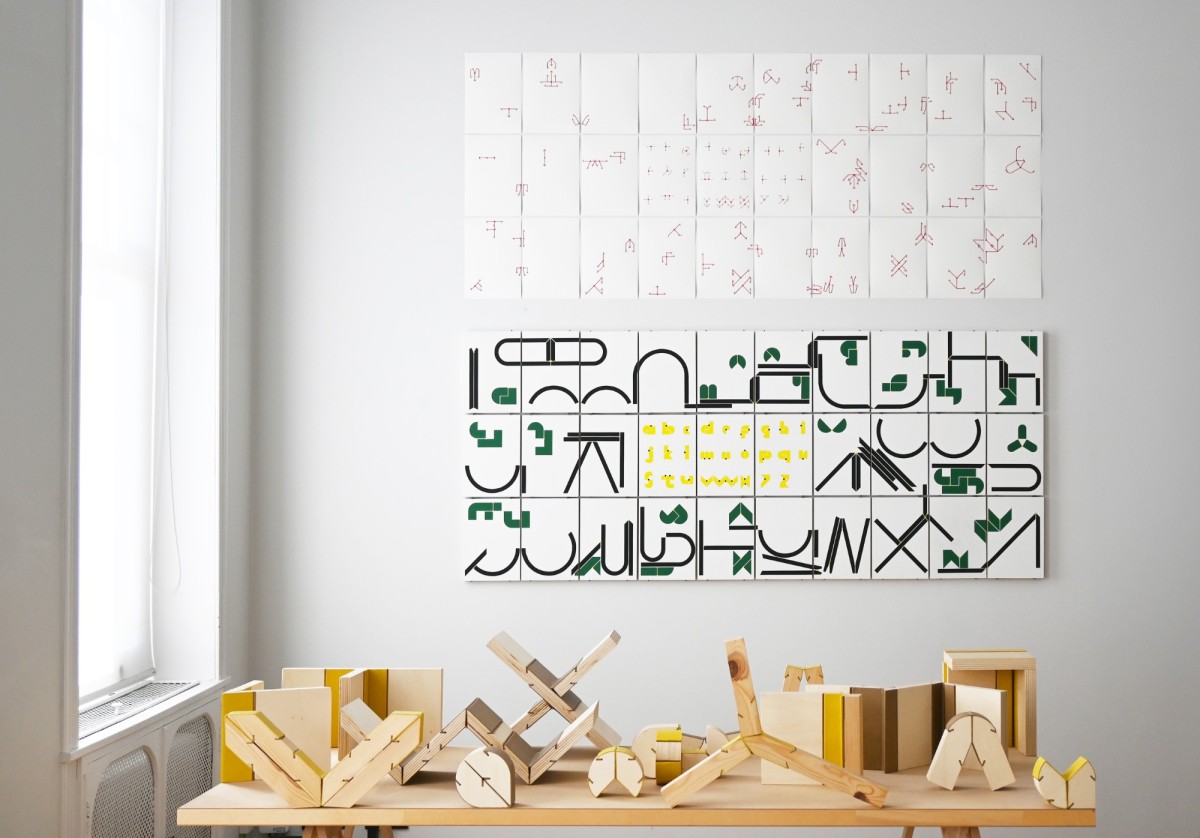
In the work LETTER PER LETTER, an attempt is made to link the visual communication of meaning through the deconstruction and reconstruction of graphemes with design methodology. Deconstructed language becomes a unique new language, eventually serving as a means of expression and leading to the act of design—giving form to objects. And so, objects are created as a metaphor. The body intrudes upon them to play with. Carefully executed gestures and rituals are crucial. The techniques applied are amateurish. What remains here is a chain of memories interwoven between time and space. This is ‘MYSELF’. It touches upon the question of my own existence. My existence that finds in between, becoming ‘ME’ in between. The ambiguous realm ultimately becomes essential, and uncertainty comes to the fore in the course of exploration. Perhaps this is the place to which we all belong. When ‘MYSELF’ is brought closer to ‘ME’, the world appears differently.
* Koji Taki, The Lived-in House (Tokio: Tabata-shoten, 1976)
Kana Arioka (JP) works beyond the boundaries between architecture, design and art. In alongside her own practice in architecture, she established her alter ego in 2022 where she explores her interest in ‘inhabited space’ – not as a living space, but as a complex text in which human time and space are interwoven. Her work unearths the ideas and imaginations that converge in ‘inhabited space’, and the space that unfolds here is not about the materially enclosed space, but space as a chain of memories shaped by a dialogue with the body.
 kana arioka
Programme
Chairperson Wouter Hessels
- 09u30 Reception/coffee
- 10u00 Trees Traversier
Introduction
- 10u10 -10u50 Hera Van Sande
Ma: architecture of the in-between
- 10u50 – 11u30 Marc De Kesel
Architect of a boundless island
A psychoanalytic perspective on the ‘self’ as space
- 11u30 – 11u50 Coffee break
- 11u50 – 12u30 Wim Goes
Embracing resistance as an invitation to engage
Flagship store Yohji Yamamoto, Antwerp
A project of Wim Goes Architectuur
- 12u30 – 13u00 Charlotte Van den Broeck
In conversation with psychoanalyst Trees Traversier and architect Hera Van Sande
on the occasion of the book Waagstukken
- 13u00 – 14u00 LUNCH
- 14u00 – 14u40 Ariane Bazan
On the loss of Ma, and what drives us: the emergence of a mental architecture.
- 14u40 – 15u20 Barbara Haverhals
Rhythm as space
- 15u20 – 15u40 Coffee break
- 15u40 – 16u20 Kana Arioka (JP)
Becoming me in between
- 16u20 – 16u50 DISCUSSIE
- 16u50 – … Nomimono & tabemono