Concierge-ism
Within the &co Barbapapa residency at De Verffabriek, we, Laure Machtelinckx and Romy Straetmans, worked out concierge-ism. The interest in the role of the caretaker arose from a shared interest in maintenance of collectively organised places.
The role of the caretaker is an underexposed role with an all too often negative connotation, which is in danger of disappearing. In many places, the tasks are increasingly being outsourced to external companies or replaced by technology, such as badge systems. Where the role still exists, it is often given a different name: logistics officer, building manager, operations officer… The tasks of the caretaker vary depending on the context. The caretaker is not only responsible for the maintenance and accessibility of the building, but also has a social role that should not be underestimated. In some contexts, the concierge can be the person who receives you, offers you a coffee and strikes up a conversation, thus being aware of interpersonal relationships and how everyone is doing.


We started by defining the role more closely using a number of verbs: welcome, maintain, build, stay, clean, listen. From there, we worked out the caretaker ism. An “ism” is a set of principles for looking at the world that define the environment and human interaction. In this way, you can apply an “ism” to memorialise a particular place or space. The principles are not fixed, but variable. They can evolve or expand. We see two possibilities for applying the concierge ism to a specific place:
Social: how can users and visitors collectively take ownership of the role?
Building: how can the building carry the role or attitude of the concierge?
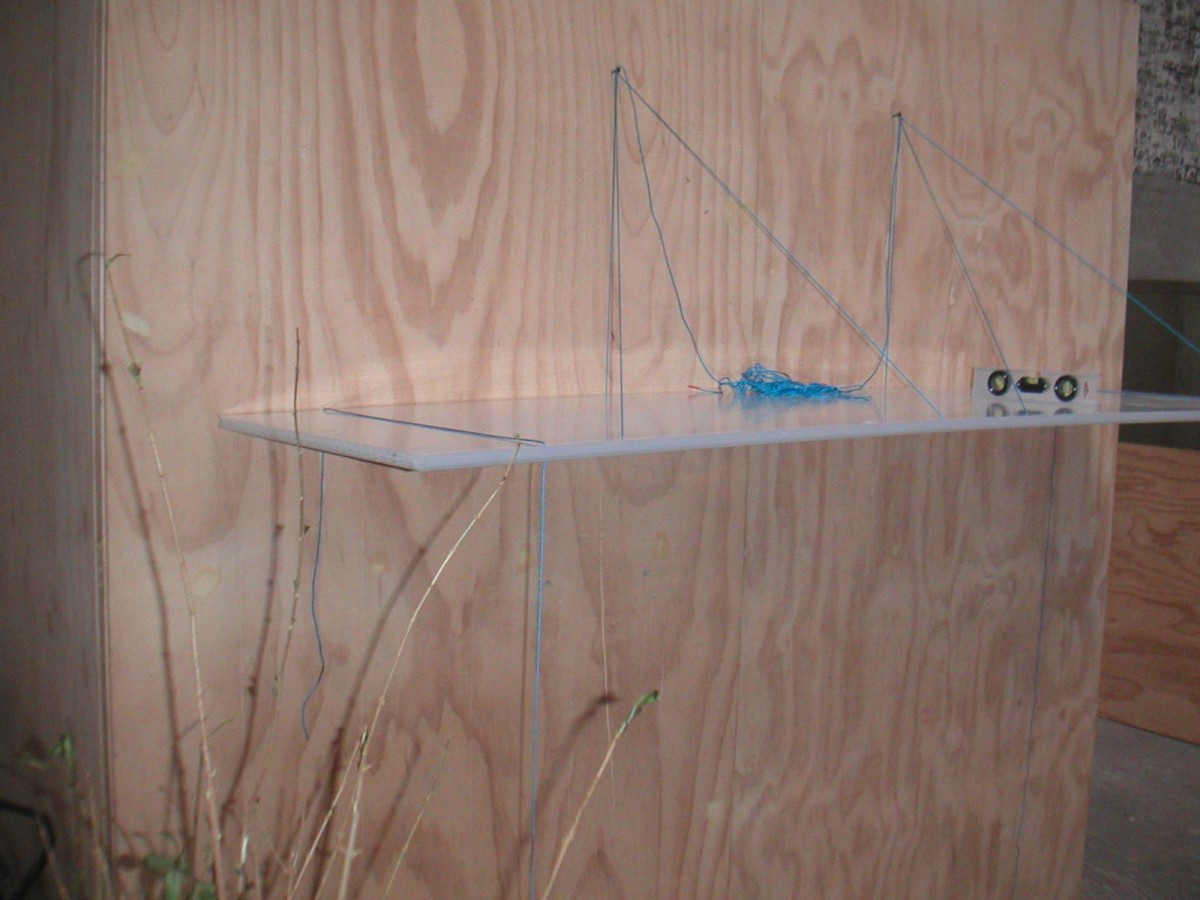
We chose to delve deeper into the second option at the Paint Factory. We came up with a whole range of possible interventions. It was impossible to further explore and implement all the possibilities within this residency. From the residency’s overarching theme of “Holding, hosting, happening”, we therefore focused on the openness and accessibility of the building. In doing so, we were inspired by a text by Wim Cuyvers, in which he writes that it is the horizontal surfaces that determine the accessibility of a space: a table, an awning, a bench… Elements on which you can sit, rest, put things or shelter under. Moreover, we felt it was important to work as much as possible with materials that were available. This resulted in a collapsible gable bench and a canopy providing protection from the rain. Above the letterbox, we also made a small shelf for a coffee thermos and a few cups for use by passers-by. So visitors and passers-by can also sit, rest, take shelter or have a cup of coffee at the facade. Even when the gate is closed.
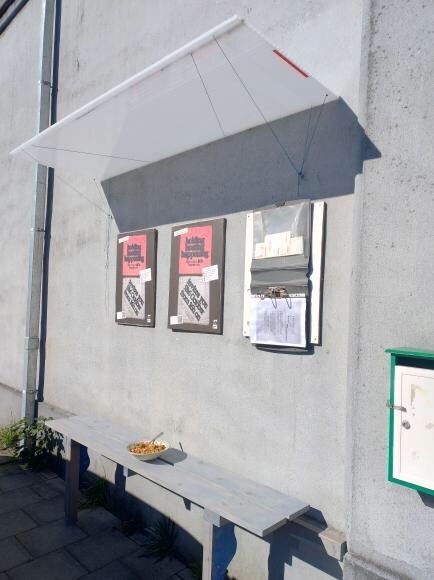
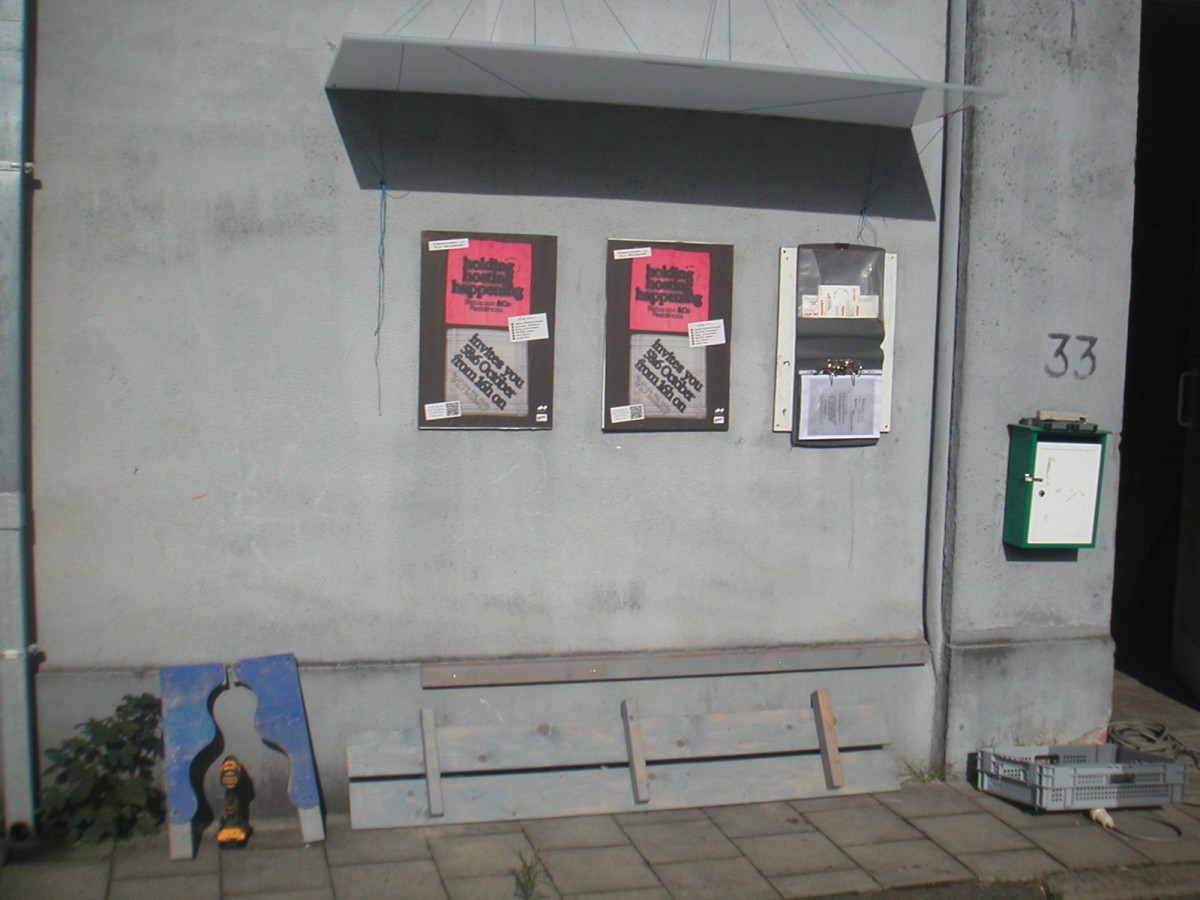
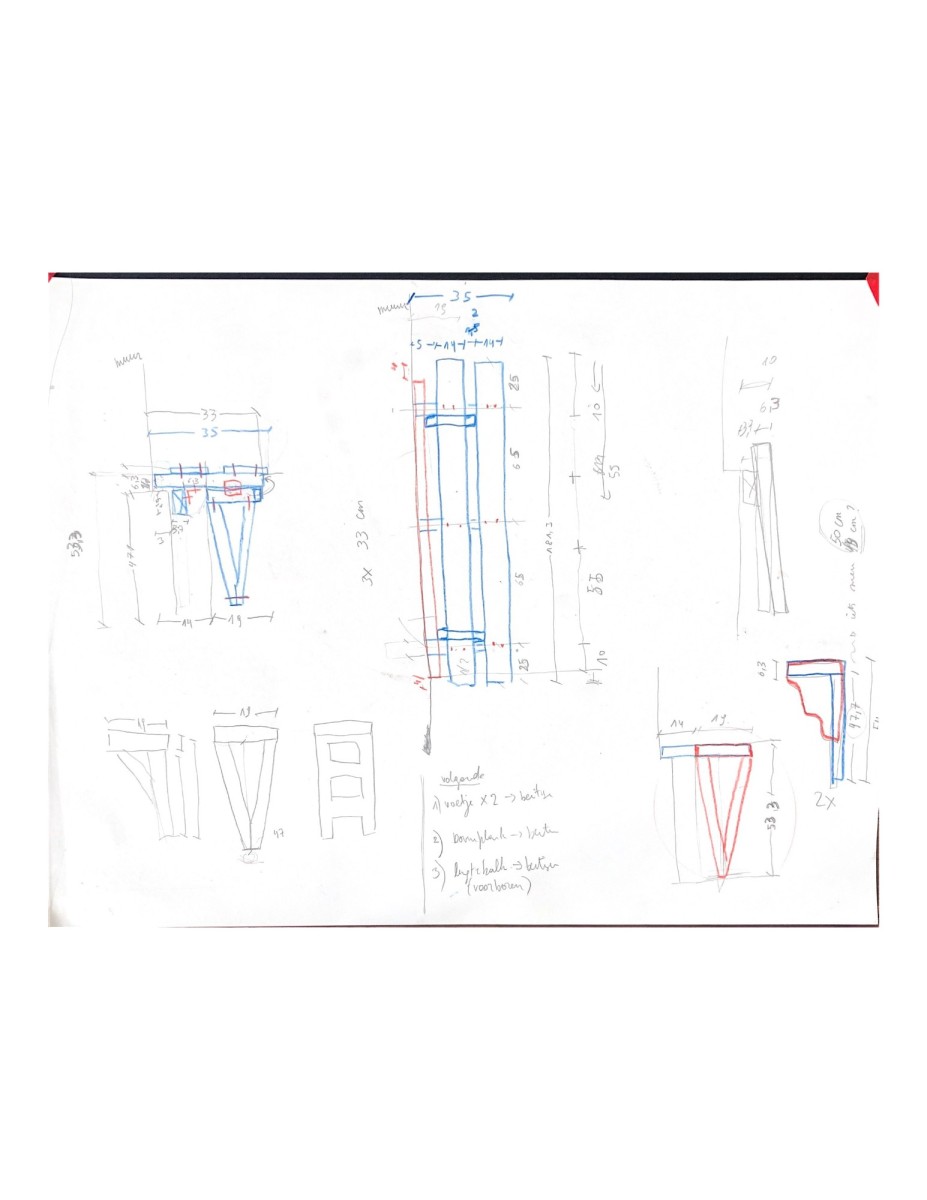
Inside, we did a number of smaller interventions and actions. Using the same logic, we searched the neighbourhood for materials to make brooms. The original idea was to make enough brooms and then distribute them around the neighbourhood to place on the facades of local residents. The idea here was to create recognition in the neighbourhood and visualise shared maintenance. Gathering the right material, however, turned out to be not so obvious, so we placed three brooms, as prototypes, on the exterior and interior walls of the Paint Factory.

Finally, there was also a tone moment at the Paint Factory. The interventions we had already made were looking for the non-language. In other words, the bench, canopy and coffee board were the decor that performed and that was good enough. To still satisfy a small enquiry into collective maintenance, we experimented with how mopping the space could become a collective activity, by making slippers out of Swiffer mops: a collective maintenance dance, to the lyrics “I don’t wanna do your dirty work, no more”, a Steely Dan song, ‘Dirty Work’.
